

Why Understanding the Whole Home Repipe Process Matters
A whole home repipe is the complete replacement of all water supply pipes in your home with new, modern materials like PEX or copper. This comprehensive plumbing upgrade addresses systemic issues that can’t be fixed with simple repairs.
Quick Answer: The Whole Home Repipe Process
- Initial inspection – Professional assessment of your current plumbing system
- Home preparation – Protecting floors, furniture, and clearing access areas
- Water shut-off – Temporary disconnection during working hours
- Pipe installation – Installing new PEX or copper throughout your home
- Testing and cleanup – Pressure testing, drywall patching, and restoration
- Timeline – Most projects complete in 1-3 days
Your home’s plumbing system works behind the scenes every day, but when pipes start failing, the problems become impossible to ignore. As one plumbing expert noted: “Many customers have told us they wish they had known earlier how easy and affordable a whole-home repipe can be, after spending so much money on successive repairs and water damage.”
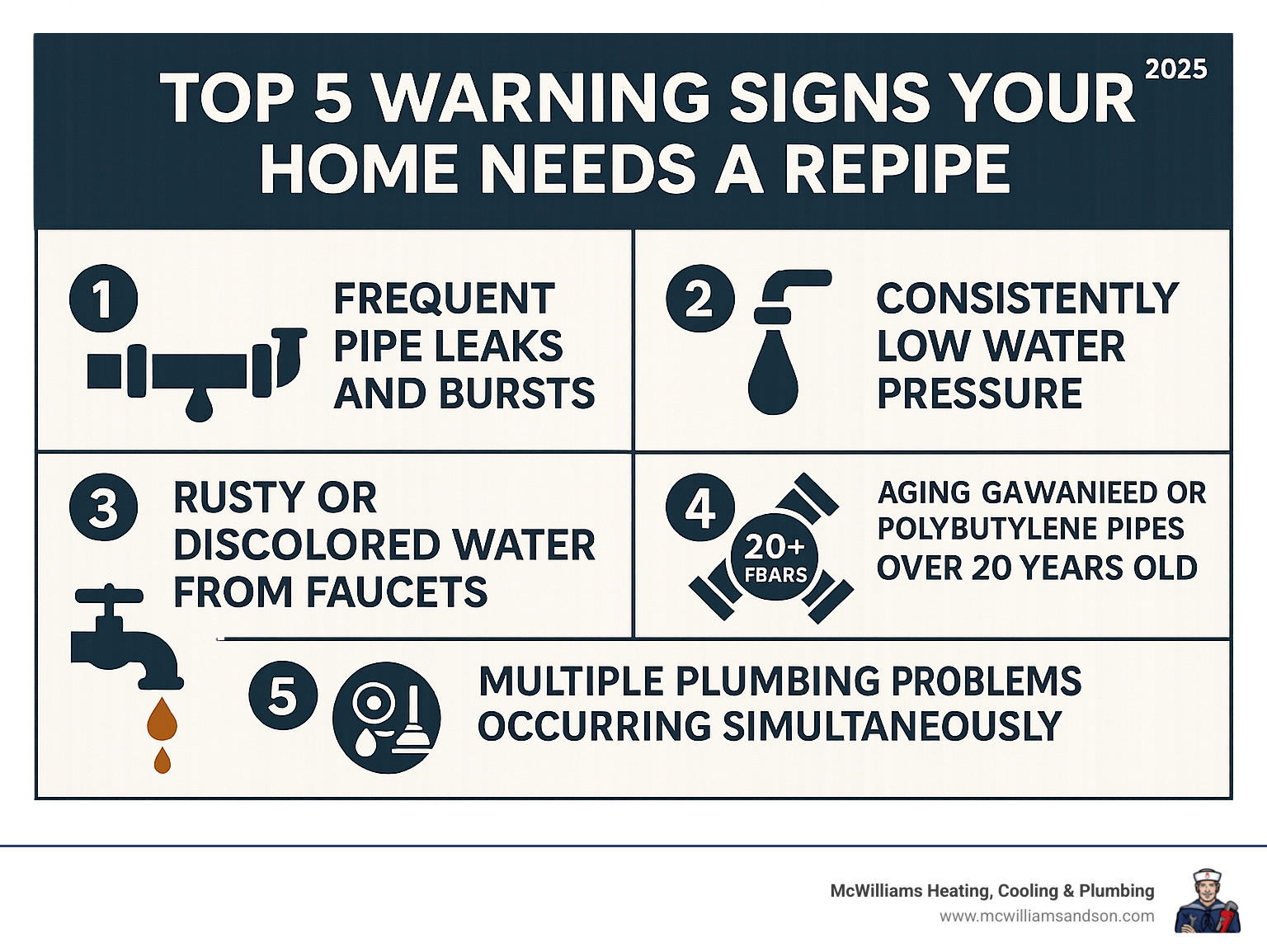
Common signs you need a repipe include:
- Frequent leaks or pipe bursts
- Low or fluctuating water pressure
- Rusty, discolored, or foul-smelling water
- Homes built before 1970 with galvanized pipes
- Multiple plumbing issues happening at once
The good news? Modern repiping techniques are far less disruptive than you might think. Most whole home repipes can be completed in just one or two days, with water service restored each evening so you can stay in your home during the process.
Is It Time to Repipe? Key Signs and Problematic Materials
Your home’s plumbing is often ‘out of sight, out of mind’—until a small drip becomes a gush. Since pipes are interconnected, damage in one area can spread. Constant repairs and low water pressure are signs it might be time for a whole home repipe.
Telltale Signs Your Pipes Are Failing
Here are the warning signs that you may need a whole home repipe:
- Low or fluctuating water pressure: If your shower loses pressure when a toilet flushes, or faucets barely trickle, it’s often due to mineral buildup or corrosion inside the pipes.
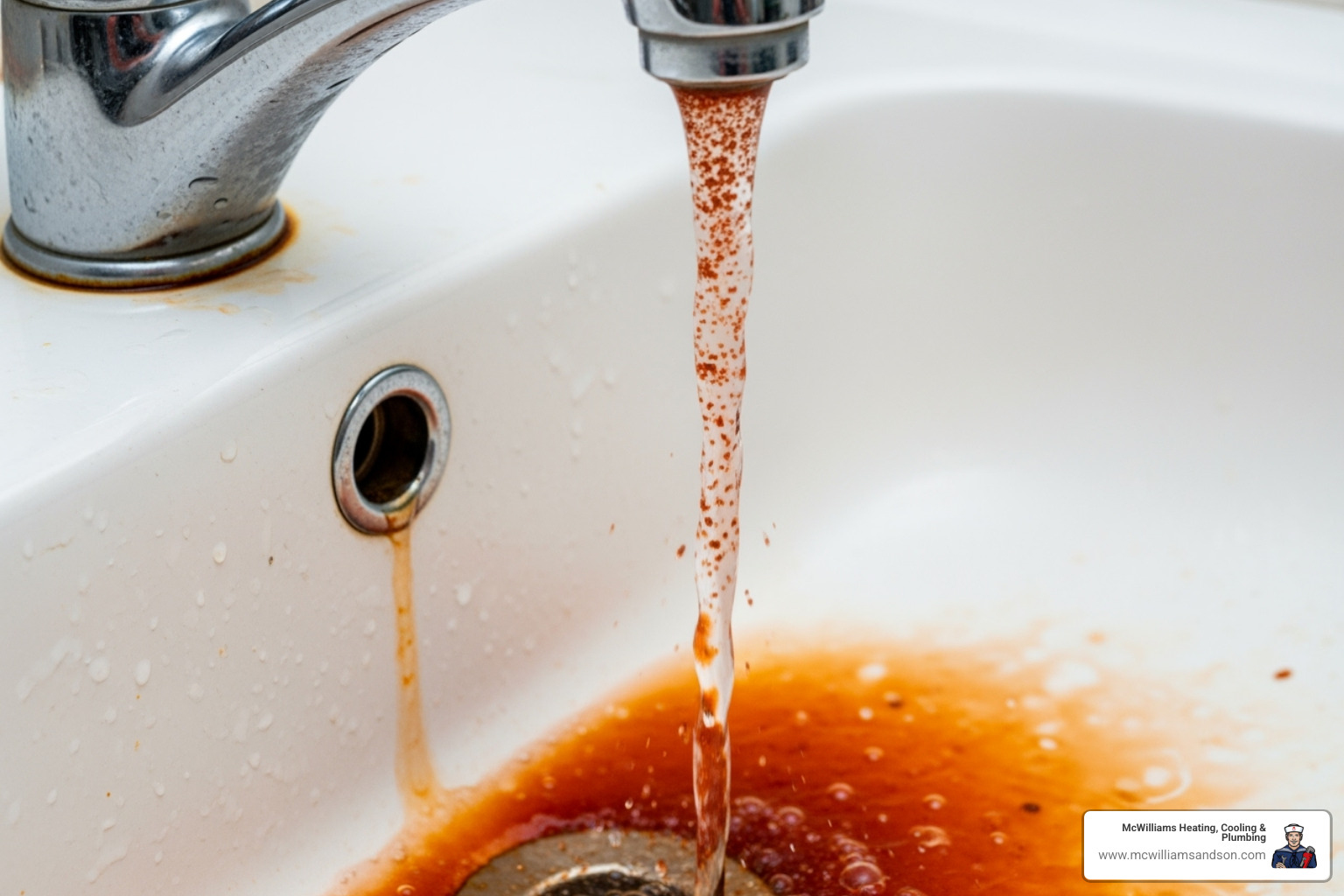
- Rusty or foul-smelling water: This is a major red flag. Discolored or smelly water means contaminants are in your supply, often from corroding galvanized pipes.
- Frequent or recurring leaks: While one leak can happen, frequent leaks indicate a systemic problem. This is especially true for pinhole leaks in copper pipes, which signal widespread internal corrosion.
- Visible corrosion: Check exposed pipes in your basement or under sinks. Discoloration on copper or rust on galvanized pipes signals internal damage.
- Home built before 1970: These homes often have outdated pipe materials. Any pipes over 20 years old warrant a professional inspection. Our team can help with Water Leak Detection & Repair to pinpoint the problem.
Problematic Pipe Materials of the Past
Some older plumbing materials are now known troublemakers. If your home has them, a whole home repipe may be a necessity.
- Galvanized steel pipes: Common in pre-1970s homes, these pipes corrode from the inside out, leading to rust, reduced water pressure, and brown water.
- Lead pipes: These pose serious health risks. If your home has lead pipes, immediate replacement is essential for your family’s safety.
- Polybutylene pipes: Used from the 1970s-90s, these pipes (also called Poly-B) react poorly with chlorine in water, causing them to degrade and fail, especially at the joints.
Partial Repair vs. Full Repipe
When dealing with systemic issues like multiple leaks or widespread low pressure, piecemeal repairs rarely make financial sense. A single repair is a band-aid on a deteriorating system, and mismatched pipe materials from past repairs can cause more problems.
A full repipe is more cost-effective long-term. The cost of continual repairs, emergency calls, and water damage can quickly exceed the price of a repipe. Being proactive is always less expensive than being reactive.
The Whole Home Repipe Process: What to Expect
The thought of a whole home repipe can be nerve-wracking, but modern repiping isn’t the demolition project you might fear. Our techniques are minimally invasive. Plumbers make small, strategic cuts to access pipes—think precision surgery, not demolition.

How to Prepare for Your Repiping Project
A little prep work helps your whole home repipe go smoothly. Here’s what you can do:
- Clear access to work areas: Our team needs to reach pipes in walls, ceilings, and floors. Clear out spaces under sinks, in closets, and in your basement or crawl space.
- Remove items from under sinks: This keeps your belongings safe and clears our workspace.
- Protect valuables: Move breakables out of work areas. While we cover floors and furniture, it’s best to store precious items safely.
- Plan for water interruptions: We shut off your water during work hours but restore it each evening. We’ll provide an exact schedule during our initial visit.
A Step-by-Step Look at a Whole Home Repipe
Our process is refined from decades of experience to be efficient and respectful of your home.
- Initial Consultation: We inspect your plumbing, discuss PEX vs. copper, and answer your questions.
- Home Protection: We lay down protective sheeting on floors and furniture in all work areas.
- Water Shut-Off: We turn off your water supply only during work hours to safely remove old pipes.
- New Pipe Installation: Our technicians make small, precise cuts to access and replace old pipes with new PEX or copper, making the fewest cuts possible.
- Testing: We pressure test the entire system to ensure no leaks and perfect water flow to every fixture.
- Patching and Cleanup: We patch the drywall holes, leaving them ready for paint, and clean up all debris.
Timeline and Disruption for a Whole Home Repipe
Most homeowners want to know how long their life will be disrupted. The answer is usually less than you think.
Most whole home repipes take just 1-3 days. Our specialized teams are efficient and can often finish in one or two days. Water service is only interrupted during working hours and is restored each evening.
While there will be some mess and noise from cutting into walls, our protective measures contain most of the dust, and our efficient process means it’s over quickly. We finish with a thorough inspection to ensure your new system is flawless. A whole home repipe is much less disruptive than most homeowners expect, and the relief of reliable plumbing is worth the brief inconvenience.
Choosing Your New Pipes: PEX vs. Copper
When planning your whole home repipe, selecting the right material for your new pipes is one of the most crucial decisions you’ll make. Think of it like choosing the foundation for your home’s water delivery system – it needs to be reliable, cost-effective, and suited to your specific needs.
Today’s market offers two standout options: PEX (cross-linked polyethylene) and copper. While both materials will dramatically improve your water pressure and quality compared to old galvanized or polybutylene pipes, they each bring unique advantages to the table.
| Feature | PEX (Cross-linked Polyethylene) | Copper |
|---|---|---|
| Cost (Material) | More affordable ($0.30 – $0.40 per foot) | Most expensive ($1 – $3 per foot) |
| Installation | Flexible, fewer fittings, easier & faster to install | Rigid, requires precise cutting, soldering, more labor-intensive |
| Lifespan | Good, but newer to market, expected 30-50 years | Excellent, proven 50+ years |
| Flexibility | Highly flexible, expands to resist freezing, quiet operation | Rigid, prone to bursting when frozen, can be noisy |
| Corrosion Resist. | Excellent, no corrosion | Excellent, but susceptible to pinhole leaks from internal corrosion |
| Water Quality | Safe, but some concern over taste/odor absorption in some types | Excellent, antimicrobial properties, no chemical leaching |
| Environmental | Petroleum-based plastic, difficult to recycle | 100% recyclable and reusable |
| UV Resistance | Poor, not suitable for outdoor use exposed to sunlight | Excellent, suitable for outdoor use |
The choice between these materials often comes down to your budget, timeline, and personal preferences. Let’s explore what makes each option special.
The PEX Advantage
PEX has revolutionized the plumbing industry over the past few decades, and it’s easy to see why. This innovative material offers a perfect blend of affordability, durability, and installation efficiency that makes it an excellent choice for most whole home repipe projects.
The flexibility of PEX is perhaps its greatest asset. Unlike rigid pipes that require numerous joints and fittings, PEX can snake through walls and around corners with minimal connections. This means fewer potential leak points and a much faster installation process. Your plumber can often run continuous lengths of pipe from your water heater to individual fixtures, creating a more reliable system overall.
Cost-effectiveness is another major draw. At just $0.30 per foot, PEX material costs significantly less than copper, and the labor savings from quicker installation make it even more budget-friendly. For many homeowners, this means getting a complete whole home repipe without breaking the bank.
If you’ve ever dealt with burst pipes during a Texas freeze, you’ll appreciate PEX’s freeze-resistant properties. The material can expand and contract without cracking, making it incredibly resilient when temperatures drop unexpectedly. This flexibility also means quieter operation – no more hearing water hammer or pipe noises through your walls.
Safety is never compromised with PEX. It’s approved for drinking water in all 50 states and won’t leach harmful chemicals into your water supply. Modern PEX formulations have addressed earlier concerns about taste and odor, ensuring your water tastes fresh and clean.
We specialize in efficient PEX Repiping Services that minimize disruption while maximizing value for your investment.
The Enduring Standard of Copper
Copper piping has earned its reputation as the gold standard in plumbing for good reason. With over a century of proven performance, copper continues to be the choice for homeowners who want the ultimate in longevity and water quality.
The durability of copper is legendary. A properly installed copper plumbing system can easily last 50+ years, often outlasting the homes they’re installed in. This incredible lifespan makes copper an excellent long-term investment, despite its higher upfront cost.
Water quality with copper is exceptional. The material has natural antimicrobial properties that help inhibit bacterial growth within your pipes, contributing to cleaner, healthier water. Copper doesn’t impart any taste or odor to your water, ensuring every glass tastes exactly as it should.
From an environmental perspective, copper shines as a 100% recyclable material. When your copper pipes eventually reach the end of their service life decades from now, they can be completely recycled and reused, making it an eco-friendly choice for environmentally conscious homeowners.
However, copper does come with considerations. The material cost ranges from $1 to $3 per foot, making it significantly more expensive than PEX. Installation also requires specialized skills like soldering, which can extend project timelines. In areas with aggressive water chemistry, copper can develop pinhole leaks over time, though this typically takes many years to occur.
For comprehensive plumbing solutions that complement your new copper or PEX pipes, we offer expert Fixture Repair and Replacement Services to ensure your entire system works harmoniously.
Both materials represent excellent choices for your whole home repipe, and our experienced team can help you determine which option best fits your home, budget, and long-term goals.
Unpacking the Costs and Long-Term Benefits
Let’s be honest about the elephant in the room. A whole home repipe represents a significant financial investment, and we completely understand why homeowners want to know exactly what they’re getting into. But here’s the thing – when you look at the full picture, repiping isn’t really an expense. It’s one of the smartest investments you can make in your home’s future.

Understanding Repiping Costs
“How much should a repipe cost?” This is probably the first question on your mind, and rightfully so. The honest answer is that whole home repipe costs can range anywhere from $4,500 to $15,000, depending on several key factors.
Your home’s size and complexity plays the biggest role in determining cost. A cozy two-bedroom, one-bath house will typically fall on the lower end around $4,500, while larger homes with multiple bathrooms and complex layouts can reach $15,000 or more.
Material choice makes a significant difference too. Remember our earlier discussion about PEX versus copper? That cost difference of $0.30 per foot for PEX compared to $1-$3 per foot for copper adds up quickly across an entire home.
Accessibility is another major factor. If your pipes are easily reachable in an unfinished basement or crawl space, labor costs stay reasonable. But when we need to make multiple cuts through finished walls and ceilings, the complexity increases.
The good news? We believe in complete transparency. When we provide your estimate, you’ll know exactly what’s included – from drywall patching to cleanup to permit fees. No surprises, no hidden costs.
We also understand that even a worthwhile investment can strain your budget. That’s why we offer flexible Financing options to help make your whole home repipe more manageable.
The Payoff: Beyond Just Fixing Leaks
Here’s where the investment mindset really pays off. A whole home repipe delivers benefits that go way beyond simply stopping those annoying leaks.
Your daily life improves immediately. Imagine stepping into a shower with strong, consistent water pressure instead of that disappointing trickle you’ve been tolerating. Picture turning on your kitchen faucet and seeing crystal-clear water instead of that rusty, questionable liquid you’ve been filtering. These aren’t luxuries – they’re the basics you deserve in your own home.
Your property value gets a real boost. When potential buyers see that a home has been recently repiped, it’s like finding gold. They know they won’t be dealing with plumbing emergencies or water damage for decades to come. A modern, reliable plumbing system can significantly increase your home’s resale value and make it stand out in a competitive market.
Your wallet benefits in unexpected ways. Many insurance companies recognize that new plumbing dramatically reduces the risk of costly water damage claims. This often translates to lower homeowners insurance premiums – savings that add up year after year.
Your family’s safety improves. If your home has old galvanized pipes or, heaven forbid, lead pipes, you’re dealing with potential health risks every time you turn on the tap. A repipe eliminates these concerns completely, giving you peace of mind about your family’s water quality.
Your modern appliances work better. That new tankless water heater you’ve been considering? It needs consistent water pressure and clean pipes to operate efficiently. Same goes for high-efficiency dishwashers and washing machines. When your plumbing system can keep up with modern demands, everything works better. This is especially important when considering upgrades like Water Heater Repair in Houston, TX.
The bottom line? A whole home repipe isn’t just about fixing today’s problems – it’s about preventing tomorrow’s headaches while improving your quality of life right now.
Frequently Asked Questions about Repiping
We get it – the idea of a whole home repipe can bring up a lot of questions. After helping thousands of Texas homeowners through this process over our 50+ years in business, we’ve heard just about every concern you can imagine. Let’s tackle the big ones that keep people up at night.
Will my entire house be torn apart during a repipe?
Here’s the good news: absolutely not! This is hands-down the biggest worry we hear, and we totally understand why. The mental image of construction crews demolishing your walls is enough to make anyone hesitate.
The reality is much gentler. Modern repiping techniques are designed to be minimally invasive. Our experienced technicians make small, strategic cuts in drywall – just enough to access the pipes we need to replace. We’re talking about precise openings, not wholesale wall removal.
Think of it more like keyhole surgery than major demolition. Our specialists have decades of experience knowing exactly where pipes run and how to reach them with minimal disruption. After we install your new pipes and test everything thoroughly, we handle the patching and texturing too. You’ll just need to add a fresh coat of paint when we’re done.
Can I stay in my home during the repiping process?
Yes! Most families stay put during their whole home repipe, and honestly, it’s usually not as disruptive as you’d expect.
Here’s how it typically works: We’ll turn off your water during our working hours (usually 8 AM to 5 PM), but we make every effort to restore service each evening. This means you’ll have running water for cooking dinner, evening showers, and all those essential overnight needs.
Since most repipes wrap up in just 1-3 days, families generally find it manageable. You might need to plan your day around the work schedule – maybe grab lunch out instead of cooking at home – but you won’t need to pack up and move to a hotel.
Of course, if you’d rather make other arrangements, that’s completely your choice. Some folks take it as an excuse for a mini-vacation!
Is repiping regulated in Texas?
You bet it is, and that’s actually great news for you as a homeowner. All plumbing work in Texas, including whole home repipes, must follow strict state and local building codes. This isn’t optional – it’s the law, and it’s designed to protect you.
Any repipe work must be performed by a licensed plumber. We’re proud to be regulated by The Texas Department of Licensing and Regulation, which means our work meets the highest safety and quality standards.
This regulation system ensures that when you invest in a whole home repipe, you’re getting work that’s done right the first time. It also means your installation will pass inspections and meet all requirements for insurance and resale purposes down the road.
Secure Your Home’s Plumbing Future
When we think back to everything we’ve covered, it’s clear that a whole home repipe isn’t just about fixing a plumbing problem – it’s about changing your home’s entire water system from a source of worry into something you can truly rely on.
Think about it: improved water pressure means your morning shower actually wakes you up instead of leaving you wondering if the water’s even on. Cleaner, clearer water means you’re not second-guessing every glass you fill from the tap. And that peace of mind that comes from knowing your pipes aren’t plotting their next leak behind your walls? That’s priceless.
But the benefits don’t stop at your daily comfort. A whole home repipe is a smart financial move that increases your home’s resale value significantly. When potential buyers see a recently repiped home, they see one less major expense they’ll need to worry about. Many of our customers have also finded that their insurance premiums decreased after upgrading from those risky old pipes to modern, reliable materials.
The improved safety and efficiency of new pipes means your family gets clean, healthy water, and your modern appliances – from your dishwasher to your water heater – can operate at peak performance. It’s amazing how much better everything works when your plumbing system can actually keep up with demand.
Here at McWilliams Heating, Cooling & Plumbing, we’ve been helping Texas families upgrade their homes for over 50 years. We understand that a repipe is a big decision, which is why we offer 7-day-a-week availability for your convenience, flexible financing to fit your budget, and free in-home estimates so you know exactly what you’re looking at before making any commitments.
We’re proud to serve families across Katy, Nacogdoches, Lufkin, Livingston, and the entire Greater Texas Area with the same commitment to quality and reliability that’s kept us in business for five decades.
Don’t let those aging pipes continue to drain your comfort and your wallet. Your home deserves a plumbing system that works as hard as you do. Contact us for professional repiping services today and take the first step toward securing your home’s plumbing future!